
You can ship a SaaS in a weekend now. Getting anyone to sign up for it can take months.
Most founders burn those months the same way. A directory here, a tweet there, a Product Hunt launch with zero preparation, a blog full of AI articles nobody reads. Then they look at the dashboard and see 14 users. Three are their friends.
My honest take: THE FIRST 1,000 USERS IS THE EASIEST MILESTONE YOU'LL EVER HIT. Not effortless. But easy, once you stop doing everything and start doing the right thing in the right order.
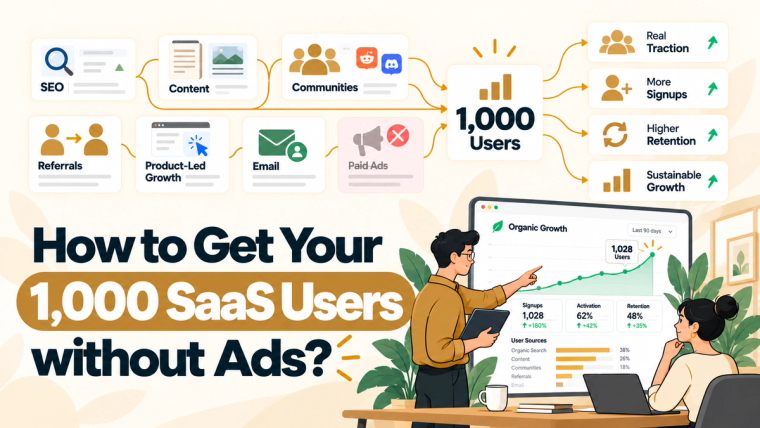
I've helped SaaS products go from nothing to thousands of signups without ads. In this guide, I'll show you the exact order I'd follow today: the Reddit method that gets your first 100 users, how to pick your channel, what to give away for free, which launches are worth it, and what to do with your first users once they show up.
What counts as a "user" when you're chasing 1,000?#
A user is someone who signs up. Free account or paid, if they created an account, they count.
Visitors don't count. You can pull hundreds of thousands of visitors from a dozen places and still have nobody using the product. Signups are the first number that tells you someone wanted what you built.
But a signup is a starting line, not a finish line. If 1,000 people register and almost nobody comes back, you don't have 1,000 users. You have 1,000 email addresses and a problem. Later in this guide, I'll show you what to do with early signups so they actually stick around.
Why do most founders get stuck below 1,000 users?#
Because they treat the first 1,000 users like a marketing problem, when it's really a focus problem. They spread thin across ten channels instead of going deep on one.
Paul Graham said it years ago in Do Things That Don't Scale: early startups have to go out and recruit users by hand. The product won't spread on its own at the start. Somebody has to carry it to people.
Look at how Tally, the form builder, got going. According to their own year one write up, they shared the first version with friends and family, then did cold outreach to creators and founders asking for feedback. That got them to 184 users by October 2020 and 750 by December. By the time they launched on Product Hunt in March 2021, they had 1,500 users. The launch doubled that to 3,000.
Notice the order. Manual work first. The launch came after they already had momentum.
In my own work, I've never had to switch channels on the way to the first 1,000. Strategies inside the channel change all the time. Some posts flop, some angles die. But once you've picked the right place, you keep showing up there with better versions. From user 1 to user 1,000, the playbook barely changes.
Here's the whole plan at a glance:
| Stage | What you do | What you're learning |
|---|---|---|
| 0 to 10 users | Friends, family, and a Reddit roast post | Does anyone care about this problem? |
| 10 to 100 users | Keep posting in relevant communities, reply to everyone, fix what people complain about | What confuses people, and what they love |
| 100 to 1,000 users | Same channel, better posts, plus Product Hunt, directories and building in public | Which source brings users who come back |
How do you get your first 100 users?#
Go to Reddit, tell the real story of what you built, and ask people to roast it. If your product works and you have zero users, this is the first thing I'd do this week.
I've run this approach many times. In my experience, it gets a working product its first 100 users at the very least, and often a lot more.
Step 1: Pick your subreddits#
Start with communities built for founders and side projects: r/SideProject, r/microsaas, r/SaaS, and founder subreddits like them. Then add the subreddits where your actual customers hang out. A note taking app belongs in student and productivity communities too, not just founder ones.
Step 2: Copy the rules before you write anything#
Every subreddit has its own rules. Some allow self promotion on certain days. Some ban links. Some ban promotion completely.
Here's a shortcut I use. Copy the subreddit's rules, paste them into ChatGPT, then turn on voice mode and just talk. Tell it how you built the product, why you built it, and what problem it solves. Ask it to shape your story into a post that fits those rules. You get your real voice, organized, and inside the lines.
Step 3: Tell the story, not the sales pitch#
The post should read like a person sharing something they made, because that's what it is. What frustrated you, what you built, what you learned, where you're stuck.
And don't drop your link. If people like what they read, they'll search your product name on Google and find you. That search is worth more than a click, because they came looking.
Step 4: Ask them to roast it#
This is the part that makes it work. Give people a reason to spend time on your product: ask them to tear it apart.
Redditors love an invitation to criticize. Let Reddit be your Simon Cowell. Brutal, a little rude, and usually right. You get dozens of people trying your product, plus a free list of everything that's confusing or broken.
Step 5: Reply to everyone, then repeat#
Answer every comment like a real person, not a bot. Fix the complaint that keeps coming up. Then do it again in the next community, with a better version of the story.
If someone asks how it works, share a link to your guide, features or installation page where the subreddit allows links. It's genuinely useful to them, and they'll find your homepage from there.
Keep this up for a week or two. Founders who postandvanish, dropping a link and disappearing, get nothing. Founders who stay in the comments get users.
Should you DM people to get your first users?#
If you sell to businesses, yes. If you sell to consumers, mostly no.
A B2B SaaS has a small, findable audience. You can identify the exact operations managers, agency owners or clinic admins who have the problem, and one customer can be worth a lot. A short, personal message to the right person makes sense. Tell them who you are, why you thought of them specifically, and ask for ten minutes of honest feedback, not a sale.
A B2C product is different. Your audience is huge and spread out, conversion from cold messages is tiny, and you can't message your way to a thousand people one DM at a time. For consumer products, communities like Reddit, creators and search do the heavy lifting instead.
Whatever you sell, never mass message strangers on Reddit. That's the fastest way to get your account banned and your brand remembered for the wrong reason.
How do you pick the right channel for your SaaS?#
Find out where your competitors' customers already talk, and start there. You don't need a 30 question workshop.
When I take on a new SaaS, I only ask the founder three things: who their competitors are, whether they sell to businesses or consumers, and who their ideal customer is. The rest is research I do myself.
The first place I look is Reddit. I search every competitor's name and read what comes up. Do people mention them? Recommend them? Complain about them? How do the competitors market themselves there, if at all? If people are already having conversations about your category, that's your channel. You just need to join them.
If there's nothing on Reddit, I check the other places the customer lives: LinkedIn for B2B, creators and short video for consumer apps, Hacker News and GitHub for developer tools.
Here's where I'd look first, depending on what you sell:
| If your SaaS is | Look here first |
|---|---|
| Niche B2B tool | Personal outreach, industry communities, LinkedIn |
| Consumer or student app | Reddit, creators, search |
| Developer tool | Hacker News, Reddit, GitHub, technical content |
| AI tool | Reddit, AI directories, Product Hunt |
| Industry specific software | Associations, niche newsletters, direct outreach |
These are starting points, not rules. Your competitor research overrides this table every time.
If Reddit turns out to be your channel and you want help doing it properly, here's how I run Reddit marketing for SaaS without getting banned.
Should you give your SaaS away for free to early users?#
Give people a real taste, not the whole meal. I prefer a freemium plan with a clear limit over giving everything away or hiding everything behind a paywall.
My reasoning is simple. Everyone should be able to try a product before they pay for it. If they can't see what it does, they won't sign up, and you won't get the feedback you need.
How I set up a freemium plan#
If a SaaS has four or five main features, I make one of them free and keep the rest on paid plans. Then I put a limit on the free one.
Say your tool writes comments for social media. Give free users 20 comments a month. That's enough to judge the quality and see how real people respond to those comments. It's not enough to run their whole workflow on it. When they want more, they upgrade.
THE LIMIT IS THE GROWTH LEVER. Too generous, and nobody pays. Too stingy, and nobody sees the value.
One warning: freemium gets abused. Some people create new accounts with new emails every time they hit the limit. People do it to the big AI chat tools all the time. Plan for it, but don't let it scare you off freemium.
How I structure pricing#
I usually go with three plans:
- A low plan with limited features at a low price.
- A middle plan that's the one I actually want most people to buy.
- A high plan for power users and teams.
The low and high plans make the middle one look like the obvious choice.
Should you give the first users free access, a discount, or a lifetime deal? That's your call. Lifetime deals can bring in early cash and feedback, but whether they make sense depends entirely on your product and costs.
What should you do with your first users once they sign up?#
Ask them for feedback, and pay them for their time. Early users are worth more as teachers than as numbers.
When I ask early users for feedback, I always offer something back. Something like: "Can I take ten minutes of your time? I'll add $10 in credit to your account," or "Your first month is on us. Use it, or pass it to someone who will." It tells them you respect their time, and they're far more likely to say yes.
Keep the ask short and specific. Ten minutes, three questions. What did you expect? Where did you get stuck? What would make you use this every week?
Why do people sign up and never come back?#
Not every signup was ever going to stay. Some people just want to see what you built. Some are competitors checking you out. That's normal.
The ones that hurt are the real prospects who leave. In my experience, it usually comes down to two things.
First, they already use something else. They sign up to see if you're better than their current tool. If your output isn't clearly better in the first few minutes, they go back to what they know.
Second, the product is hard to use. People are busy. If the interface confuses them, they won't spend twenty minutes figuring it out. They'll just leave. Paying users especially expect it to be easy and fast.
The fix for both is the same: get a new user to the main result as fast as possible. Watch where your first users get stuck, and remove that step.
Are Product Hunt, Hacker News and directories worth it?#
Yes, but as boosts, not as your whole plan. Launch on Reddit first, then use Product Hunt, Hacker News and directories to add bursts on top of what's already working.
Product Hunt#
A good Product Hunt launch is worth the prep. Tally doubled its user base with one. And it keeps paying after launch day. I've looked at analytics for clients who launched there a year or two earlier, and they're still getting a steady trickle of new users from Product Hunt every week.
How to prepare:
- Pick your date a few weeks ahead and tell your friends, family and early users when it is.
- Make sure they actually try the product before launch day, so their comments are real.
- Ask for honest feedback in the comments, not compliments and not upvotes.
- Be there all day to answer every comment yourself.
What you shouldn't do is have people create accounts just to vote, or ask anyone to upvote you. Launch platforms watch for coordinated voting, and getting flagged on launch day undoes all the prep.
Hacker News#
For the right product, Hacker News can be a gold mine. Some founders get thousands of their first users from a single post. It works best for developer tools and technical products with a real story behind them.
Read the Show HN guidelines first. Your product has to be something people can actually try, not a landing page or waitlist. And Hacker News explicitly says not to ask friends to upvote or comment.
Directories#
Directories are the cheapest win on this list. Submit to G2, Trustpilot, alternatives directories, and every AI or SaaS directory in your niche. Search Google for "AI tools directory" or "SaaS directory," or ask ChatGPT for a list of free ones. You'll find dozens.
When I worked on an AI tool for students, our first signup spikes came from directory listings. They won't carry you to 1,000 on their own, but they give you early users, a few backlinks, and places for people to find you while you work on everything else.
Do friends, referrals, creators and building in public actually help?#
They all help, at different speeds. Friends and family come first, creators come fast, and referrals come slow.
Start with friends and family#
Whatever you're building, your first users or customers are almost always people you know. Tell them about it, ask them to use it, and ask them to be brutally honest. If people who know you find it useful enough to keep using, strangers probably will too. If they quietly stop, that tells you something just as important.
Referral programs take time#
Referral programs work, but they take a while to take root. They need a base of happy users who actually want to share you. At 50 users, that base barely exists yet.
Creators can speed things up#
If you want faster growth, reach out to creators in your niche and strike a deal. You set the terms. For example, pay them a bonus if their video hits a certain number of views, or give them a share, say 40%, of whatever a paying user they bring in pays you. Small creators are often surprisingly affordable.
Build in public, everywhere#
Post your journey on X, LinkedIn and anywhere else your audience reads. Got your first 10 users? Post it. Your first 100? Post it. First paying customer, first launch, a Reddit post that blew up? Post every one of those.
Those milestones are interesting to other founders, and on X especially, one of them can take off and send you a wave of signups. Share what went wrong too. People trust the founder who admits mistakes more than the one who only posts wins.
What does this look like in real life?#
Here's the story that shaped how I think about early users.
I was the first marketing hire at an AI tool for students. We had no playbook. For the first couple of months, we tried social media and a handful of other platforms. SEO brought readers. Directory listings brought small signup spikes. But nothing was taking off.
About two months in, I pushed for Reddit. Students were already there, asking how to use AI for research and essays. We didn't need to find our audience. It was already having the conversation.
So we joined it. Real stories, useful answers, no link spam.
And it worked. Posts went viral, and we got thousands of users from Reddit, free and paid. By our internal count, our first 30,000 to 40,000 users came from Reddit activity. That still ranks as one of my favorite journeys.
The lesson isn't "Reddit always works." It's that we stopped spreading across channels and went all in on the one where our users already were.
What should you track on the way to 1,000 users?#
You don't need a fancy analytics stack. Your own database already knows who signed up, when, and what they did. Start there.
What your database won't tell you on its own is where each user came from. So add two simple things.
First, put UTM tags on every link you share, so you can see whether a signup came from Reddit, Product Hunt or a directory. Second, add one optional question to your signup form: "Where did you hear about us?" Lots of Reddit users won't click your link. They'll search your name later. That question catches them.
Then watch four numbers each week: new signups, where they came from, how many came back after their first visit, and how many paid. If a source brings plenty of signups but none of them come back, it's not really working.
FAQ#
How long does it take to get 1,000 users?#
There's no universal timeline. It depends on your product, your audience and how consistently you show up. Tally took around six months to pass 1,000. Others get there in weeks from one strong Reddit post or launch. Focus on the weekly habit, not the deadline.
Can you get 1,000 users without paid ads?#
Yes. Reddit, communities, directories, launches, friends and family, and building in public can all get you there for free. It costs time instead of money.
Is Reddit the best channel for every SaaS?#
No. It's the first place I look, because so many SaaS categories are discussed there. But if your competitors' customers aren't on Reddit, go where they are.
Should I launch on Product Hunt with zero users?#
I wouldn't. Launch on Reddit first, get your first users and some feedback, then launch on Product Hunt when you have people who've actually used the product and can comment honestly.
Are 1,000 signups enough to know I have a good product?#
Not by itself. Watch how many come back and how many pay. A thousand signups who never return is a messaging or product problem, not a win.
Stuck below 1,000 users? Let's find your first channel#
Send me your product link, who it's for, and how many users you have right now. I'll dig into your competitors, find where your customers are already talking, and send you back three things for free:
- The first channel I'd focus on, and why
- The first post I'd write there
- The biggest thing on your site or signup that's costing you users
No call required, no pitch deck. Just a clear starting point.
Get your free first users plan
And if you'd rather have someone run the whole thing with you, here's how I work as a SaaS growth consultant.

Zain Ul Abdin is a full-stack marketer who helps startups and service businesses grow through SEO, content strategy, social media, Reddit marketing, and go-to-market strategy. His work has helped businesses and projects reach 100K+ users, generate 50M+ search impressions, and achieve 100M+ Reddit impressions. He shares practical marketing insights based on real projects and experiments.
More articles by Zain